Start with the work, not the extractor sticker
HSE says welding and flame cutting turn up in motor vehicle repair when removing or repairing parts and releasing seized components. The risks are wider than the bright arc. Heat can affect paint, underseal or galvanised coatings, adding harmful fumes and gases. Working under or inside a vehicle can restrict the space around the job. [1]
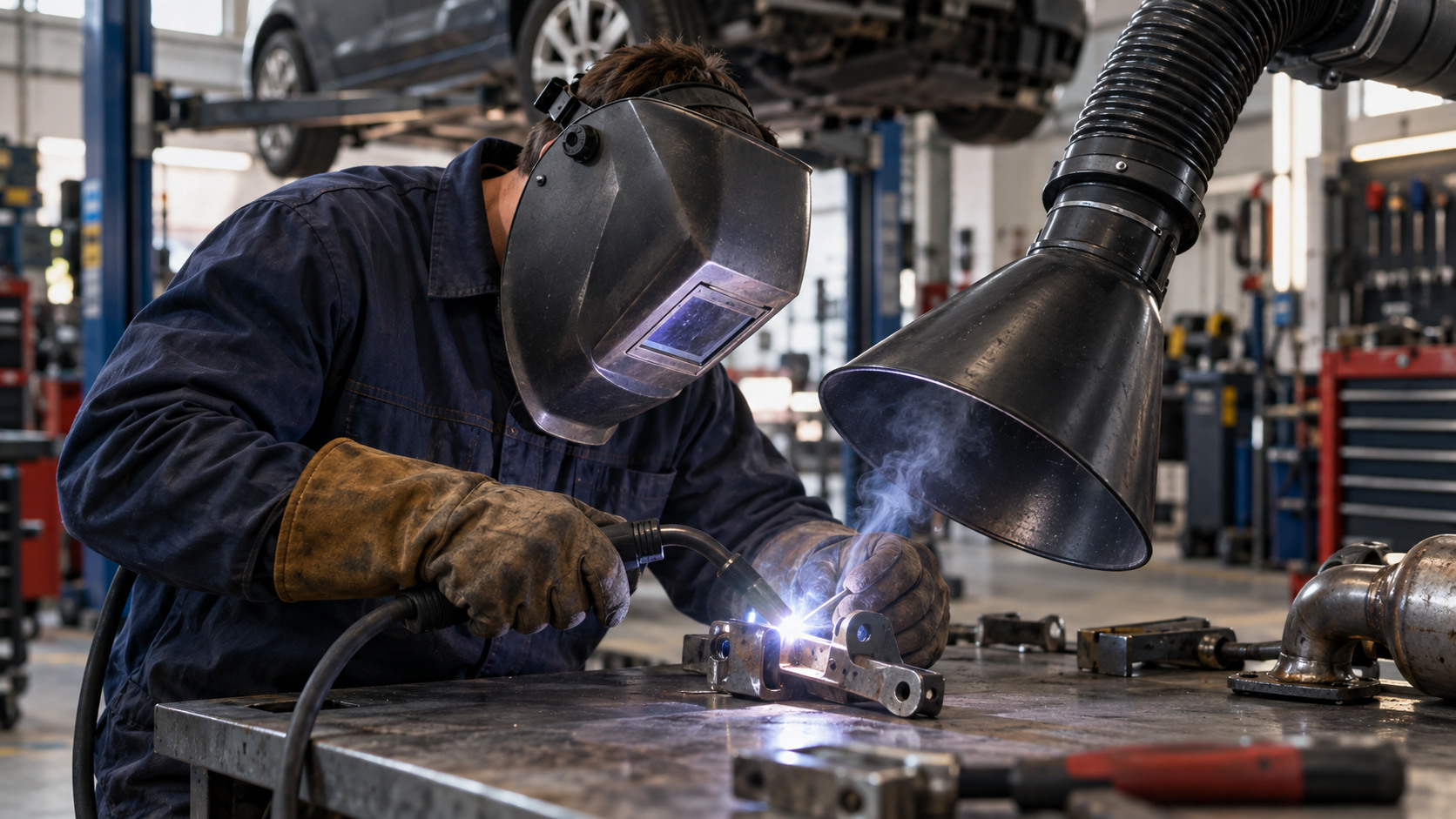
My view: the extractor is easy to admire when it is parked neatly against the wall. That is not where the weld is. HSE says mobile units with flexible trunking and hoods can remove fume from many positions, but the hood must be as close as possible to the fume source. Its broader welding guidance says movable hoods depend on the worker positioning and moving them as the job progresses. [1][2]
The image above is an AI-generated editorial illustration, not a measured safe distance or a certified setup. Airflow, the workpiece, draughts and the actual hood all matter. An illustration cannot prove control in your bay.
Does every short weld need a mobile unit?
No blanket claim from me. HSE's motor vehicle repair advice says use local exhaust ventilation, or LEV, wherever possible. It says always use it in confined locations or when welding stainless steel, and use it when heat may affect coatings such as paint, underseal or galvanising. For small-scale work with no LEV available, it calls for a free flow of air and good general ventilation. [1]
HSE's wider welding guidance adds a useful distinction for sporadic work. Engineered fume controls are not normally expected for occasional welding done less than once a week and lasting less than an hour, provided suitable respiratory protective equipment, or RPE, and good general ventilation control exposure. It gives a car mechanic making an occasional short exhaust-support repair as an example. That is not a free pass for a coated panel, a confined space or an unassessed job, and people nearby still need protection. A task-specific risk assessment decides the controls. [2]
If LEV alone does not adequately control exposure, or cannot reasonably be provided, HSE says suitable RPE is needed. A tight-fitting mask needs an appropriate face-fit assessment; a particulate filter does not protect against welding gases. The choice is more than grabbing whichever mask is in the cupboard. [2]
What I would check before striking the arc
First, identify the metal and anything heat could reach: coatings, trim, fuel lines and nearby containers. HSE separately warns against hot work on containers that may hold flammable residues. If cold joining can do the job, consider it before welding. [1][2]
Second, look at the actual capture point. Can the hood sit close to the weld without obstructing safe work? Will it be moved when the weld moves? Is the unit working and has its competent-person examination and test been kept current? HSE's garage guidance gives a 14-month interval for LEV examination and testing. [1]
Third, consider everyone else breathing the bay air, not just the person under the visor. General ventilation and any RPE have to match the assessed job. If fume still visibly escapes the capture zone, stop and revisit the controls rather than letting the workshop become the filter. [2][3]
This is established guidance, not a new October rule. The opportunity is a quick, honest look at a routine setup before a short repair becomes somebody else's lungful.