Start with the pause, not the finish
There is a tempting little shortcut after a painting job: lift the visor, admire the finish and get on with the next thing. HSE warns against lifting the visor too soon. The important detail is what remains in the air, not whether the spray gun is still running. Spraying two-pack isocyanate paints produces fine, invisible mist that can cause occupational asthma. People nearby can be affected too. [1]
This is an explanation of established HSE guidance for Great Britain, checked on 16 October. It is not a new October deadline, a booth inspection or a paint-spraying qualification. Northern Ireland businesses should check their own applicable guidance. If your garage does not carry out this work, it is not an instruction to buy a spray booth.
I would start a bodyshop review with one question: what happens between the last spray and the next unprotected person approaching the job? Ask the sprayer, the supervisor and the person who might arrive with a query. I would want a consistent answer, not three versions depending on how busy the afternoon feels.
HSE also makes a useful product distinction: water-based does not automatically mean isocyanate-free. Check the actual materials rather than treating the marketing description as the risk assessment. [1] My suggestion is to take one current job through that conversation. Which products are involved, who checks them and where does the agreed working method live? A familiar tin should not make those questions disappear.
For me, the opportunity is a clearer handover. The person waiting outside should not need to guess whether silence means access is allowed. Make the pause part of the job everyone understands, rather than a private habit known only to the regular sprayer.
Find the measured time, not a convenient number
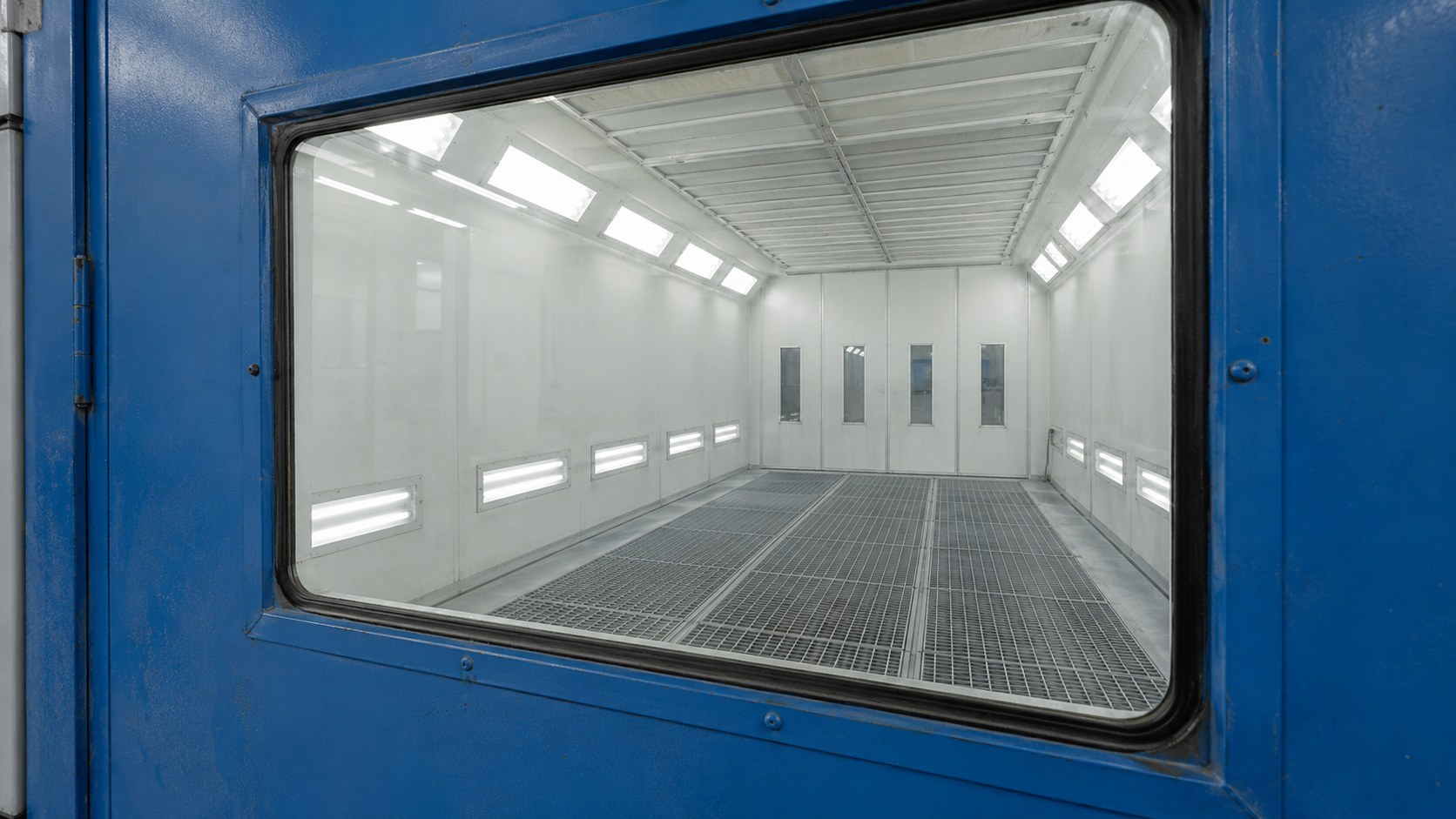
Clearance time is the time needed for the booth or room to clear its mist. HSE tells owners to measure it, mark it clearly on entrance doors and make sure users know the arrangements. It is not a number to borrow from the booth down the road. [1]
HSE publishes a smoke or fog testing procedure. It says the clearance time should be checked just before the filters are changed and recommends including the test in the booth's thorough examination and test. Its guidance says local exhaust ventilation, the extraction system controlling the contaminant, should be thoroughly examined and tested at least every 14 months; some systems need more frequent testing. [2]
I would ask for the actual record and match it to the enclosure in front of me. Is everyone discussing this booth, in its relevant operating condition, or a remembered number from an old conversation? Put that question to the competent person responsible for the assessment and examination. This article is not a substitute for HSE's full test procedure, and it is not an invitation to improvise one between customer jobs.
The published procedure uses an empty enclosure and rounds the measured time up to the next quarter minute for the entrance notice. [2] Those details are why I would resist a casual stopwatch experiment with whatever happens to be inside. A measurement is useful because its method means something, not simply because someone wrote down a time.
My practical review would connect three things: the test record, the displayed instruction and what people actually do. If they disagree, I would treat that as an unresolved control question for the responsible specialist, not tidy the paperwork until it looks reassuring. A polished notice cannot repair a misunderstood process.
Keep protection in the conversation
HSE says filtering respirators are not suitable for spraying isocyanate paints: the respiratory protection must be air-fed breathing apparatus. It specifically identifies lifting the visor to inspect a fresh finish as an exposure problem. That is not solved by calling the look a quick one. [3]
There is a very practical point behind that warning. HSE suggests tear-off visor covers and adequate lighting to help visibility. It also explains that the breathing-air supply has to meet the equipment manufacturer's minimum conditions and that the low-flow warning should immediately alert the wearer to insufficient supply. [3]
I would ask what makes someone want to lift the visor. Is the view poor? Does the working method leave an awkward inspection step? Has the team accepted an inconvenience as normal? Those are questions for the equipment supplier, competent adviser and people doing the job together. My view is that telling someone to try harder is a thin response when the practical difficulty has not been examined.
I would also ask the team to explain the agreed safe exit and re-entry arrangements. HSE says sprayers need to know how to leave or enter safely during clearance time. [1] The details belong in the assessed method for that installation and its equipment, not a generic sequence copied from a blog.
For a manager, a useful outcome would be knowing who owns each unresolved question and when it will be answered. Do not let a familiar mask, a closed door or a confident explanation stand in for that answer. This is about checking a system of controls, not choosing a reassuring object to point at.
Check exposure as well as the equipment
HSE explains why equipment and behaviour need checking together: physical controls can deteriorate or fail, while working practices can vary. Its biological monitoring guidance describes urine analysis as a way to check paint sprayers' exposure to isocyanates. That is a check on exposure, not a test of a person's health. [4]
The distinction matters when discussing results. HSE says an end-of-shift sample reflects that shift and sampling should be representative. Raised results should prompt investigation into how exposure is happening, corrective action and subsequent retesting. The provider should supply suitable interpretation and advice. [4] I would keep that discussion with the competent provider rather than trying to turn a result into a diagnosis at the workshop counter.
Separately, HSE calls for regular health surveillance for people potentially exposed. [1] I would ask who coordinates that arrangement and how the team raises concerns, without collecting private medical details in an ordinary job record. A clear route to appropriate professional help is more useful than an informal guessing session.
My short review would finish with four answers: the relevant measured clearance time, the agreed access arrangements, the protection and maintenance responsibilities, and the arrangements for checking exposure and health. If an answer is missing, give the gap a named owner and obtain competent advice before relying on the control.
The point is not to stretch every job with an arbitrary delay. It is to respect the pause that the assessed work actually needs. A lovely finish is worth looking at. It is not a reason to make the air someone else's guess.