The van is in for a tyre. The wheel is off, the airline is ready, and the next move feels familiar. This is where I would pause for one extra question: are we treating a light-commercial tyre as though it were an ordinary car tyre? HSE says some light-commercial tyres are inflated to around 70 psi and may cause serious injury if they fail. Its guidance calls for enhanced precautions where that risk is present. [1]
This is established HSE guidance, not a new September rule. It does not mean every van tyre has the same pressure or that every tyre job needs the same restraint. The tyre and wheel, their condition, the manufacturer’s recommended pressure and the work being done determine the safe method. [1][2]
Why the usual car-tyre assumption can fail
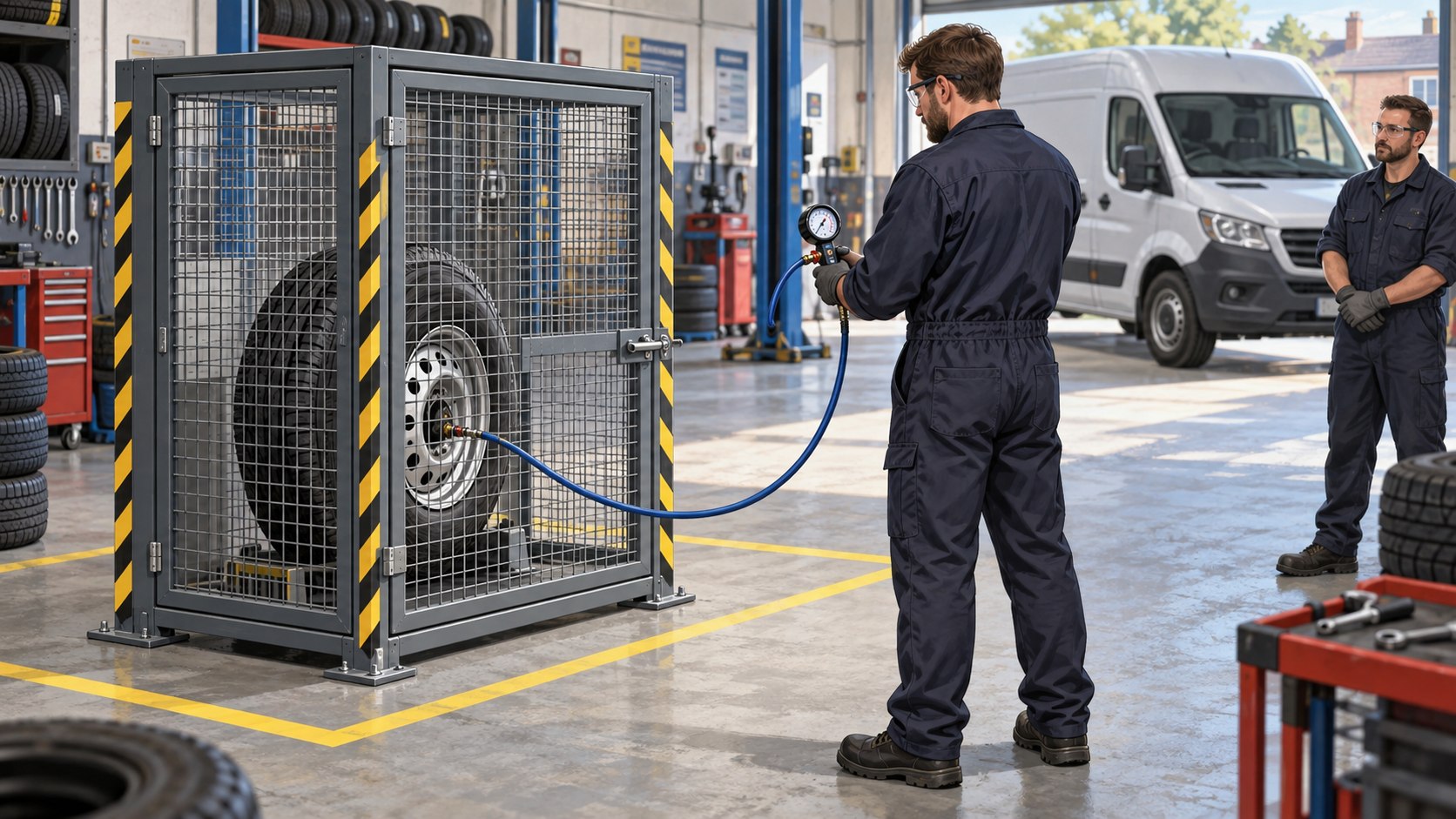
Compressed air stores energy in the tyre. HSE warns that a failure can release a violent blast and send fragments into the workshop. A fitter standing beside the sidewall may be in the likely path of that blast. A long enough hose lets the operator use the gauge and control from a safer position, away from that trajectory. [1][2]
HSE draws a distinction: sensible precautions are needed for car tyres, but a safety cage is not normally necessary for a new car tyre or a replacement tyre confidently free of hidden damage. Larger commercial tyres are different. For larger single-piece commercial tyres inflated above 15 psi, including some light-commercial tyres, its INDG433 leaflet calls for extra measures such as a suitable restraining device. The current HSE web page likewise says that where a light-commercial tyre's pressure may cause serious injury, inflation above 15 psi should include a restraint. The 15 psi point describes the inflation stage where extra controls matter; it is not a recommended running pressure. [1][2]
Restraint and distance work together
A strong, firmly secured cage is one example, but it is not the only option HSE describes. Depending on the tyre and job, a secured horizontal stool with a clamp or a suitable portable restraint may be appropriate. The equipment must be suitable for the wheel and the risk, not just present somewhere in the building. A marked exclusion zone around a fixed cage helps keep other people clear. [1][2]
The airline needs a clip-on chuck, an accurate gauge or pressure control, and enough length for the operator to stand outside the likely explosion path. HSE advises quick-release couplings so a suspected failure can be dealt with from that safe position. Do not use a connector that must be held on by hand, an unrestricted airline, or a control valve jammed open. Never exceed the tyre manufacturer's recommended pressure for its size and rating. [1][2]
Check the tyre before deciding to reinflate
Pressure is not the whole story. HSE's leaflet warns that a tyre run significantly underinflated may have internal cord damage that is not obvious from outside. It advises checking the pressure before deflation, inspecting externally and internally for signs of damage, and not reinflating if there is doubt. If a possible sidewall failure appears during inflation, do not walk up to the tyre to deflate it; use the quick release from the operator's safe position. [2]
There is another boundary worth spotting early: split-rim or multi-piece wheels need additional precautions and experienced, competent staff. A fabric bag suitable for some single-piece wheels is not designed for a split-rim wheel. If the wheel construction is unfamiliar, stop and identify it before loosening anything. [1][2]
What I would check in the tyre bay
My practical checklist is simple: identify the wheel and tyre type; check its condition and correct pressure; decide whether a suitable restraint is needed; make sure the clip-on airline, gauge and quick release work; then stand clear and keep colleagues out of the likely blast zone. If the kit or competence is missing, refer the job rather than improvise. That is my workshop prompt drawn from HSE guidance, not a replacement for a competent assessment of the specific tyre. [1][2]
The opportunity is a safer, more confident service for van customers. The risk is letting a familiar-looking wheel carry a commercial-vehicle hazard into an ordinary car-tyre routine. [1]