Why a small battery needs a proper plan
This is about conventional lead-acid vehicle batteries, not the high-voltage traction pack in an electric car. HSE's motor vehicle repair guide treats the 12 or 24-volt lead-acid battery as its own topic. It warns that charging can produce hydrogen and oxygen inside the battery. If the gas ignites, the case can shatter and throw fragments and corrosive liquid. A short circuit from a metal tool can also cause burns or sparks. [1]
The awkward bit is timing. HSE says gassing increases as a battery nears full charge. A vented battery may release trapped gas when moved after charging. A so-called maintenance-free, valve-regulated battery is less likely to vent, but it is not a free pass: charging too fast or too long can open its pressure-relief valves. [1]
None of this is a newly announced battery rule. It is established safety guidance worth applying to an ordinary job, especially if the charger has gradually migrated onto a crowded parts bench.
Give charging a place, not just a plug
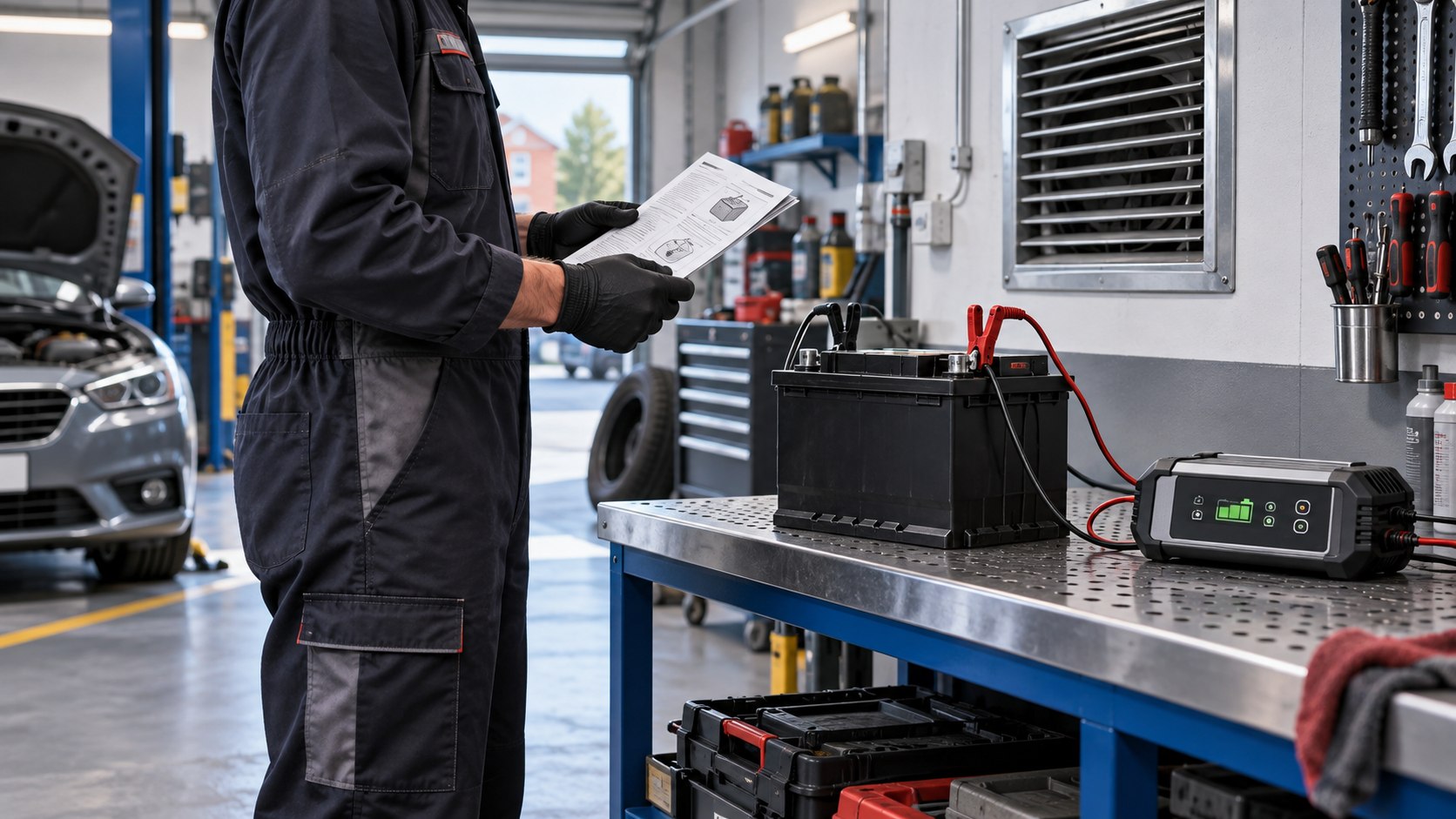
HSE's battery guide says to use a dedicated, well-ventilated charging area. It also says to keep smoking, hot work and possible ignition sources away. That makes the usual multipurpose bench a question to revisit if somebody also grinds, welds or stores loose metal tools there. Ventilation has to suit the actual space and charging setup; an open door elsewhere in the garage is not a measured guarantee. [2]
Check the battery manufacturer's charging instructions and that the charger suits its voltage and charging rate. HSE favours a controlled charger that reduces current as the battery fills, because it cuts the risk of overcharging and gassing. If the battery sits in a compartment, the battery guidance says to open its lid or doors before charging so gas does not collect. [1][2]
This is also a handling job. Keep metal tools off and away from terminals, and use suitable eye protection where acid or mist may be present. A vented battery's electrolyte contains sulphuric acid, which can seriously damage skin and eyes. [1][2]
The last connection is still part of the job
HSE says many battery explosions happen while connections are made or broken. Its normal charging sequence is to switch the charger off before attaching the leads, make secure connections, then switch it on. Switch it off again before removing the leads, unless the charger maker specifies a different procedure. Do not adjust live charging leads. If the battery is fitted to a vehicle, check the maker's instructions and the vehicle's electrical requirements as well. [2]
For a vented battery, HSE advises leaving it standing for at least 20 minutes after disconnecting the charger before the careful final top-up to the manufacturer's level. Do not assume that same top-up step applies to a sealed battery. [2]
What I would do this morning
I would ask three questions at the charging point: is this really a ventilated, dedicated space; is this charger right for this battery; and does everyone know the off-before-leads routine? If any answer is fuzzy, pause the charge and sort the setup before making it a habit. HSE's more detailed battery leaflet is a better basis for the local risk assessment than a handwritten "be careful" sign. [2]
My view: a charger earns its own tidy corner. The risk is not that every charging battery will explode. It is that a routine job can put gas, a spark and someone's face in the same place when nobody has thought through the bench.