The MOT certificate gets plenty of attention at a garage counter. The recall question deserves a little of its own. Those are different checks, and treating one as the answer to the other is an easy way to leave an awkward gap in a perfectly tidy job card.
This is a practical reminder from current government guidance, not a new October rule or a newly announced recall. Nor is it a list of allegedly dangerous models. I want to look at the decision a real workshop faces: what do we check, what do we tell the customer, and when should the planned job stop being the immediate priority?
The certificate is useful, but read its limits
GOV.UK says an MOT checks important vehicle parts against legal standards. It does not cover the condition of the engine, clutch or gearbox. That alone should discourage us from translating a pass into "everything about this car is fine". [1]
Recall information can sit alongside the test result. In England, Scotland and Wales, an MOT certificate may tell the owner about a safety recall, depending on the manufacturer. The same government guidance says the driver remains responsible for keeping the vehicle safe whenever it is driven. [2]
My reading is straightforward: use a recall warning when it appears, but do not treat a certificate with no warning as proof that there is nothing to investigate. That conclusion follows from the stated manufacturer-dependent information, not from a claim that I have tested every manufacturer's data feed.
For an MOT tester, keep the testing decision and the recall enquiry distinct. Follow the current inspection manual for the actual test. This article is not authority to invent a failure item, overlook a defect or change a test result.
Start with the car, not a frightening headline
GOV.UK directs people with a car's registration to the MOT-history service to see safety recalls that have not been checked or fixed. Without the registration, the separate recall search uses manufacturer, model and year of manufacture. These are useful routes into the enquiry, not a workshop diagnosis. [3]
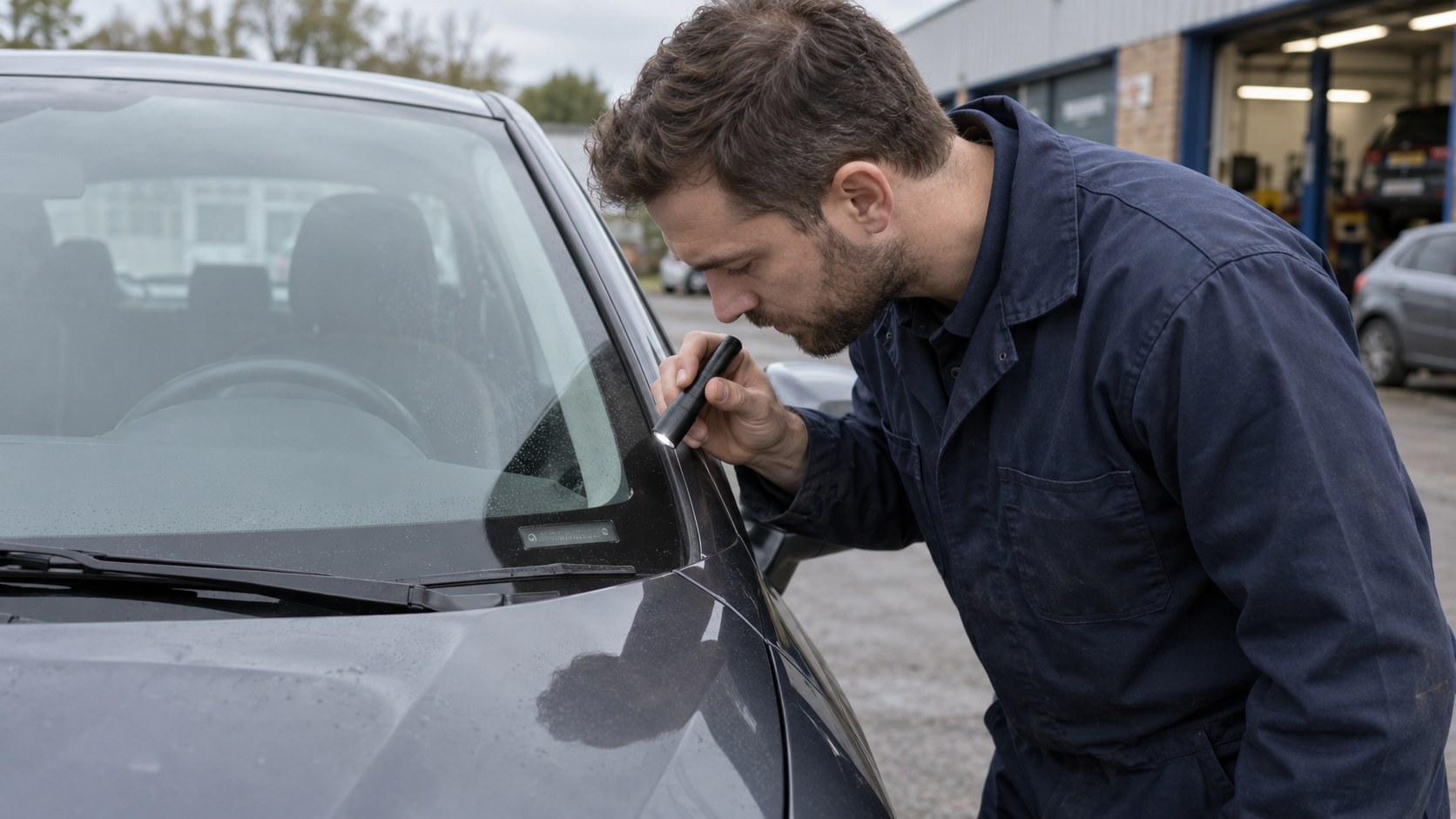
My suggested intake routine is to verify that the details you are using belong to the vehicle in front of you. If the manufacturer needs its vehicle identification number, or VIN, obtain the correct one through the appropriate identification point and its instructions. A similar model name is not a substitute for the exact vehicle.
The feature photograph illustrates that identification stage. It is an AI-generated fictional scene, not evidence that this particular car is recalled, that a check has been completed or that anyone has carried out a repair.
Then keep the search result and the next action together. An entry saying that a campaign needs attention should trigger contact with the manufacturer or its nominated repair route. If information is unclear or appears inconsistent, ask that route to confirm the position for the exact vehicle. Do not smooth away uncertainty with a confident sentence at collection time.
Read the instruction before planning the journey
The manufacturer's safety-recall letter normally explains the reason, what to do next and whom to contact. Repairs or parts under a safety recall are usually not charged for. "Usually" matters: it is not a promise that every unrelated fault or additional workshop job will be free. [2]
There is a more important boundary than the price. GOV.UK says that if a vehicle has a serious safety defect, the manufacturer will tell the owner what to do and the vehicle must not be driven. [3]
So do not suggest "drive it over to the dealer" as the automatic answer. Establish the applicable instruction first. Where a stop-driving instruction applies, do not road-test the vehicle or tell the customer that a short trip is harmless. Ask the manufacturer about the safe arrangements for that vehicle, including getting it to the repair location without driving it where required.
My practical advice is to make the unresolved instruction visible to the person planning the job. Otherwise, the desk may carefully record a concern while someone else innocently schedules a road test. A note nobody sees is not much of a safeguard.
This does not mean every recall search result proves the same defect, urgency or remedy. It means a garage should get the actual instruction rather than guess from the word "recall". Do not claim that an ordinary service, a warning-light reset or an MOT has completed a manufacturer's campaign unless the applicable repair process and confirmation support that statement.
Leave a useful trail, not a vague reassurance
Here is the job-card addition I would use. It is my suggested working routine, not a newly mandated form.
Record when the check was made, the source used and the vehicle details checked. Keep any relevant campaign reference and the instruction obtained. Separate what the garage has confirmed from what still needs the manufacturer's answer.
Record what the customer was told, who will arrange the next contact and whether any driving restriction needs to be addressed before the vehicle moves. Keep identifying details in the appropriate private job record, not in a public photograph or a social post.
If the customer says the recall work has already been done, ask for suitable confirmation and resolve a conflicting result through the manufacturer. My advice is to record the answer you actually received, not turn "customer thinks it was done" into "campaign completed".
At collection, explain the boundary in plain English: the MOT result is one piece of information; the recall check and any manufacturer action are another. It is perfectly possible to be helpful without pretending to know more than you do.
My view: this is a good place for a garage to earn trust. No dramatic sales pitch, no invented deadline, and no promise that your usual service covers every campaign. Just identify the right vehicle, check the right source and make the next safe action clear. The certificate can keep its moment in the spotlight. It does not need to do a second job it was never given.