DVSA's MOT testing guide was updated on 22 September 2026. Its update note says the brake-testing section now clarifies how to measure the roller brake tester floor plate when part of the vehicle standing area is outside the building. This is a clarification in authorisation guidance, not an announcement that every existing MOT station must move its tester this week. [1][2]
The class 4 measurement that matters
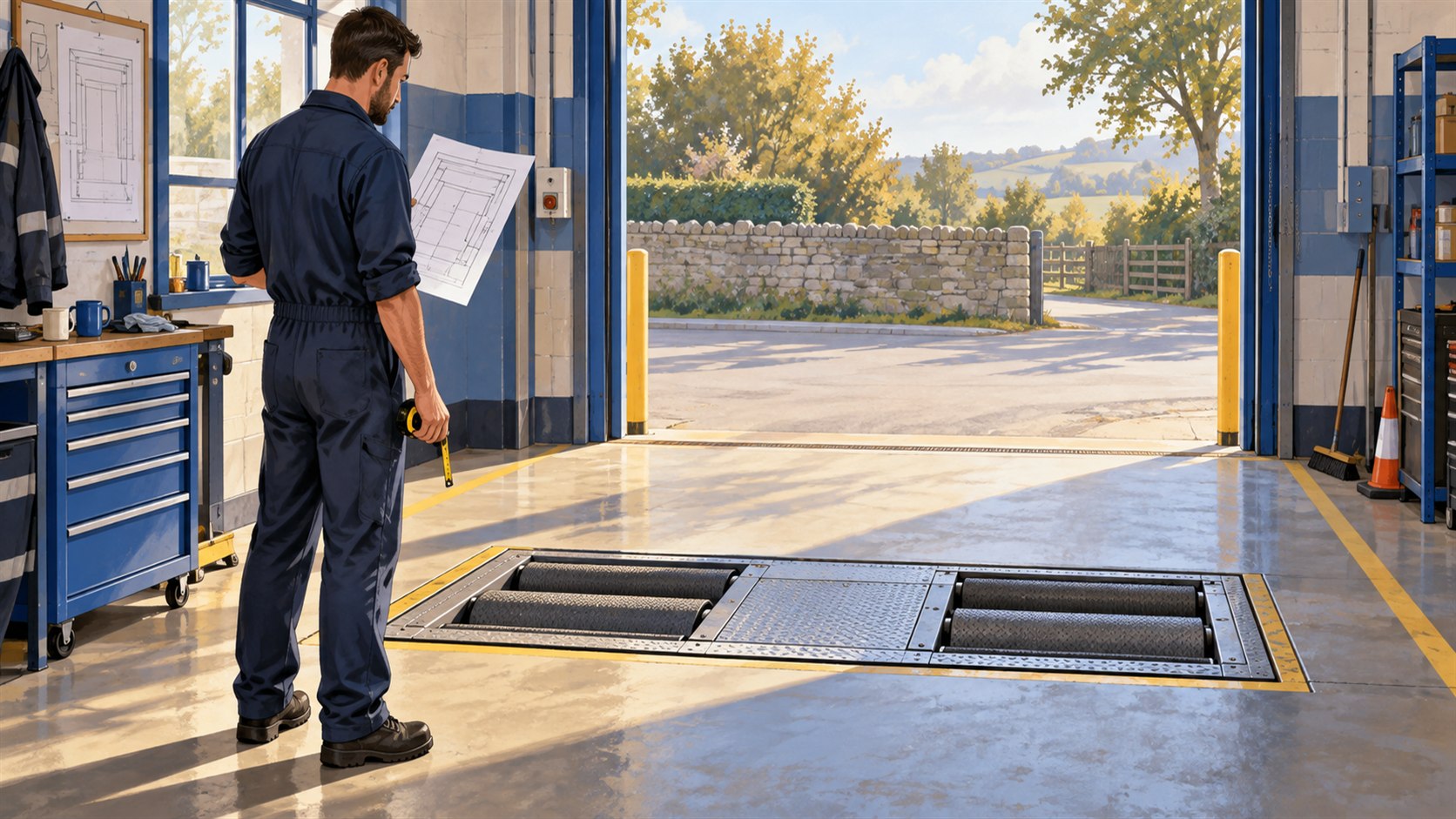
For a class 4 roller brake tester, DVSA allows part of the brake-testing standing area to be outside. The first part of the tester's floor plate must be at least 1.5 metres inside the building, measured from the doorway. There is a stated exception: if the doorway meets the class 7 width requirement, the 1.5 metres may instead be measured from the roller brake tester centre line. Do not apply that exception to an ordinary doorway without checking its actual width against the guide. [2]
That is not the only dimension on the drawing. The tester must sit centrally in an unobstructed working area at least 9.0 metres long and 2.4 metres wide. At least 3.35 metres in front of and behind its centre line should be substantially level; the remaining area has a maximum 10% slope. Any outside standing area must stay off a public thoroughfare. These are class 4 requirements, so a door-to-plate measurement alone cannot sign off the whole bay. [2]
Why a tape measure before the invoice?
Imagine a garage sketching an MOT bay close to an entrance because there is plenty of apron space outside. The tempting calculation is to count that apron, centre the rollers and call it done. The guide asks for more: the specific doorway-to-floor-plate distance, the clear working area, the levels and the boundary of any public thoroughfare. My view is that finding a problem on a drawing beats finding it after the concrete has set. [2]
There are other layout traps. In a drive-through class 4 arrangement with the tester after a lift or pit, DVSA specifies at least 3.35 metres between the lift platforms and the tester centre line. Lift lead-off ramps must not intrude into that area. It also requires at least 600 millimetres between any part of the tester and a pit, lift platform or lift recess, except for cross-pit rollers. The equipment manufacturer's installation instructions still matter. [2]
Who needs to act?
If you are applying for a new MOT site, adding a test class or changing a layout, put the current Section D requirements beside the dimensioned plan before committing to building work. The guide says an authorised examiner must apply to DVSA for approval before replacing or modifying fixed test equipment in a way that changes approved dimensions or layout, or altering the building or equipment layout. It says supporting drawings should accompany a VT01 application. It separately requires notification of changes to fixed or connected equipment through the MOT testing service's 'Change testing equipment' link. [2]
If your approved class 4 bay is unchanged, the 22 September update note does not itself instruct you to rebuild it. Keep the distinction between a clarified measurement for plans and an order to alter an existing installation. If your own arrangement is in doubt, check it against the current guide and seek DVSA's view before making changes. [1][2]
And do not copy class 4 numbers into a class 7 plan. Section D gives class 7 its own working-area dimensions and describes the 1.5-metre inside-building condition using the tester centre line. The class and doorway details are part of the answer, not fine print to skip over. [2]
What I would put on the plan
I would mark the doorway line, the first edge of the tester floor plate, the tester centre line, the full standing area and any public boundary. Then I would check the relevant class-specific dimensions, levels, lift or pit clearance and manufacturer's requirements with whoever is designing the bay. That is a practical checklist drawn from DVSA's guide, not a substitute for its authorisation decision. [2]
The opportunity is simple: a better drawing now can prevent an expensive rework later. The awkward little 1.5-metre line deserves its own pencil mark. [2]