A garage can have a spotless workshop and still give a customer an awkward first job: work out which way to walk while somebody moves a car. The reception door is obvious to the regulars. That does not mean the route to it is obvious to everyone else.
The question I would ask is simple: can a visitor reach reception without improvising a path through vehicle movements? It is a useful question before spending money on another sign.
HSE's motor-repair guidance says workplace transport puts workers and customers at risk. It recommends separating vehicles and pedestrians where possible, safe customer parking and reception areas, slow vehicle movement and less reversing. Its examples include a pedestrian struck outside a workshop doorway by a reversing car. [1]
I am looking at established Great Britain guidance, not announcing a new October requirement. Northern Ireland has a separate health-and-safety system. This is a practical review prompt, not a site-specific traffic plan, an instruction to alter a public highway or proof that a layout is safe.
Start where a visitor actually arrives
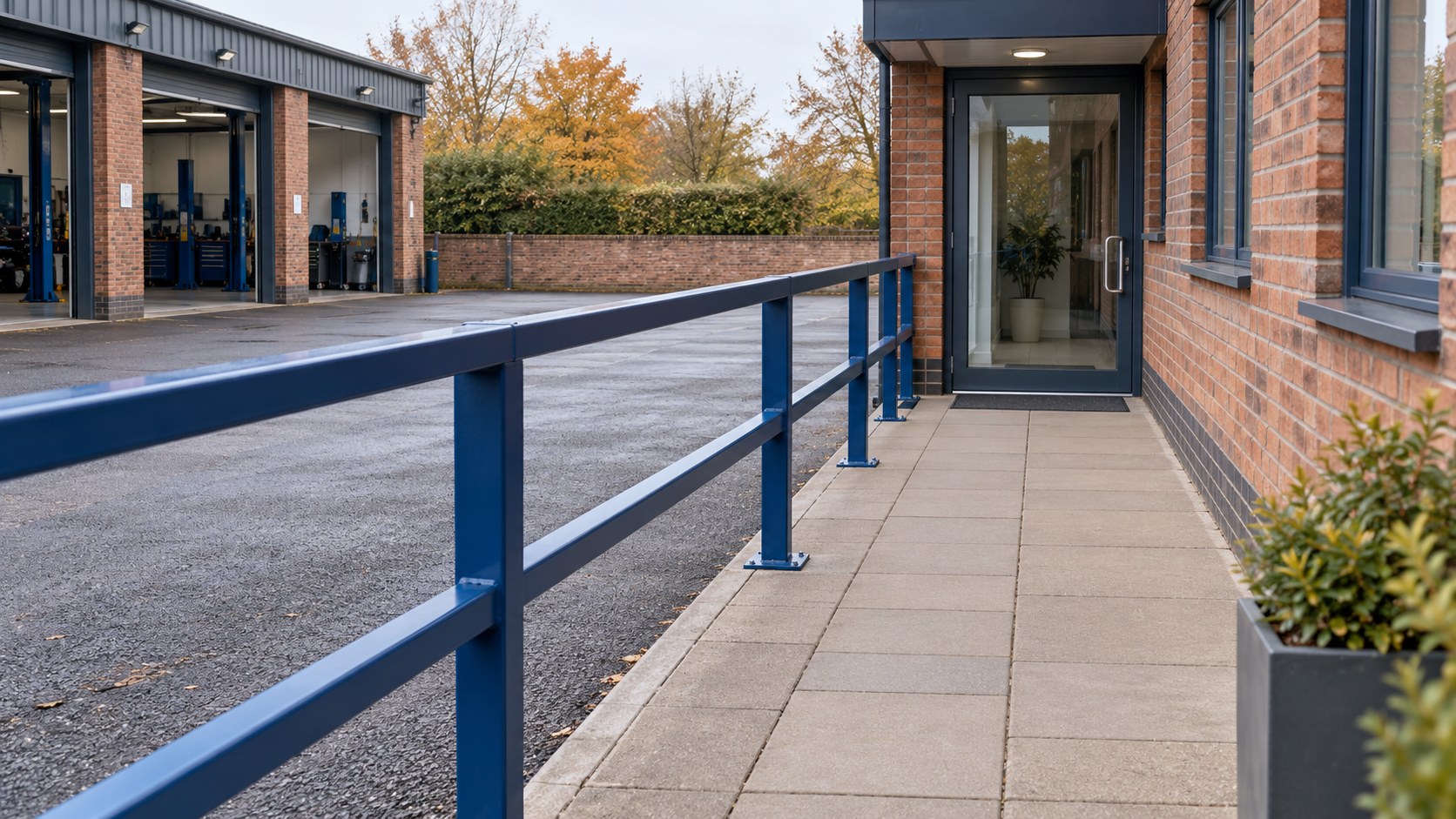
HSE's guidance on separation says pedestrian routes should, where possible, follow the paths people naturally want to take. It also says traffic routes must not threaten pedestrians using doors or gates. [2]
My suggested starting point is to look at the journey from the customer's parking place to reception. Do this from a safe position while normal work is happening, without creating a staged near miss. Ask a colleague who does not usually greet customers to explain the route.
What would someone do if they arrived for the first time? Where would they stand to find the door? Does the apparent entrance lead through a vehicle bay? Is the intended route available, or occupied by a delivery, parked car or stack of tyres?
A fictional example: the pedestrian route runs along the building, but a van left beside the wall blocks it. The visitor now has to choose between waiting and stepping into the vehicle lane. Painting the route did not keep it usable. My first response would be to resolve the obstruction and the parking arrangement, not criticise the visitor for taking the shortcut.
I would include people who cannot use an awkward kerb or narrow gap comfortably. A route that only works for someone squeezing sideways between bumpers is not the arrival experience I would want to offer. Get competent advice where accessibility or the physical layout needs a proper redesign.
The practical opportunity is a calmer handover. A clear arrival route lets the receptionist greet a person rather than rescue them from the wrong end of the workshop. That is my view, not a measured claim about sales or accident reduction.
Separate the route from the movement
HSE advises separate pedestrian and vehicle routes wherever possible, with suitable barriers, markings or kerbs where appropriate. Where routes cross, it calls for appropriate crossing points with clear visibility, marking and signs. Separate pedestrian and vehicle doors are recommended where possible. [2]
I would review the actual separation before ordering paint. Which part keeps a person out of the vehicle path? What happens at the doorway? Where is a crossing genuinely unavoidable? A line can explain a route, but I would not assume it will stop a vehicle.
For a small garage, my suggestion is to sketch the existing movements with the responsible manager: customer arrival, staff walking between buildings, parts deliveries and cars entering or leaving bays. Use the sketch to identify conflicts, not as an instant engineering certificate.
Then decide what can be removed from the conflict. Perhaps customer parking needs a different arrangement. Perhaps a delivery cannot happen beside the pedestrian entrance while customers are arriving. The right answer depends on the site, vehicle types and assessed risks. A large site's one-way system is not automatically a small site's solution.
I would make the safe instruction short enough to give at booking and repeat on arrival. Tell the customer where to park and how to reach reception. Do not send them into a working area to find someone. If the normal route is temporarily unavailable, tell them what to do instead before they encounter the obstruction.
This is also a staff conversation. I would ask who keeps the route clear and who can stop a movement when the arrangement is not working. A route with no responsible owner is liable to become everybody's temporary storage space.
Reduce reversing before adding a helper
HSE's reversing guidance starts with removing the need to reverse where possible and minimising it where unavoidable. Reversing areas should be planned and marked, and people who do not need to be there kept clear. [3]
My suggested review is to follow a typical vehicle journey on paper. How many backward movements are built into an ordinary arrival, bay transfer and collection? Which are necessary, and which result from where the previous car was left?
Do not trial a new movement through customers to see whether it works. Have the responsible person assess and explain a safe arrangement first. I would include unfamiliar controls and the competence of whoever is moving each type of vehicle in that discussion, rather than assuming every car behaves like the last one.
A signaller is not a spare person waving vaguely. HSE says a trained signaller needs agreed signals, a safe position and continuous visibility to the driver. If the driver loses sight of them, the driver should stop immediately. [3]
I would not ask a customer, apprentice or passing colleague to stand behind a reversing vehicle as an improvised fix. If the assessment calls for a signaller, provide the necessary training and safe system. Mirrors, alarms and cameras are aids to consider, not a reason to abandon separation.
Check the doorway when the light changes
HSE's lighting guidance requires suitable and sufficient workplace lighting. It highlights yards, pedestrian routes and manoeuvring areas, warns that tall vehicles can block light, and discusses glare and sudden changes between bright and dark areas. Lights should be maintained and their covers kept clean. [4]
My autumn suggestion is to review the entrance under the conditions the garage actually uses. A sunny midday glance does not answer the early-morning or late-afternoon question. Arrange the review safely; nobody needs to stand in a vehicle path to test whether a driver can see them.
I would note dark patches, dazzle, obscured lights and places where someone emerges from a door into vehicle movement. Pass defects to the competent person responsible for lighting or the traffic arrangement. Do not treat a brighter lamp as an automatic cure for a poorly separated route.
Finally, revisit the arrangement when parking, deliveries or work patterns change. My suggested short record is the conflict found, the action agreed, who owns it and when it will be checked again. If no change is needed, record why the existing arrangement remains suitable rather than inventing work.
The useful result is not a prettier line on the ground. It is a visitor who knows where to go, a driver who knows where people may be, and a garage that has deliberately kept those movements apart. Start at the front door. It is part of the workshop job.